
History
After driving for 4 km along a road overlooking part of the Bay of Alcudia, the islet of Alcanada, and the exclusive golf course of the same name, once the gates open and you enter the Sa Bassa Blanca Museum, you find yourself in another world.
You arrive at the top of a hill from where the sea and the house can be glimpsed. It is an authentic architectural manifestation realized in 1978 by the famous Egyptian architect Hassan Fathy (1900-1989). White, crenellated walls conceal a Hispano-Moorish courtyard where two twin fountains cool the air circulating through the arches.
The building, initially designed as a dwelling, was converted into a museum in 2006 and classified as a Registered Asset (Bien Catalogado) in 2012. Lovers of modern and contemporary art can visit the new rooms where works by the great Italian artist Domenico Gnoli, an installation by the well-known German artist Rebecca Horn, and works by other internationally renowned artists like Meret Oppenheim, Miralda, Takis, and Alan Rath are exhibited.
Another floor is dedicated to the pictorial and sculptural work of the Vietnamese artist Vu Cao Dam or to temporary exhibitions and the spectacular and very well-preserved Mudéjar coffered ceiling dated 1498, originating from a chapel in Tarazona, cataloged as a Cultural Asset of Interest to the Heritage of the Balearic Islands (Bien de Interés Cultural – BIC).
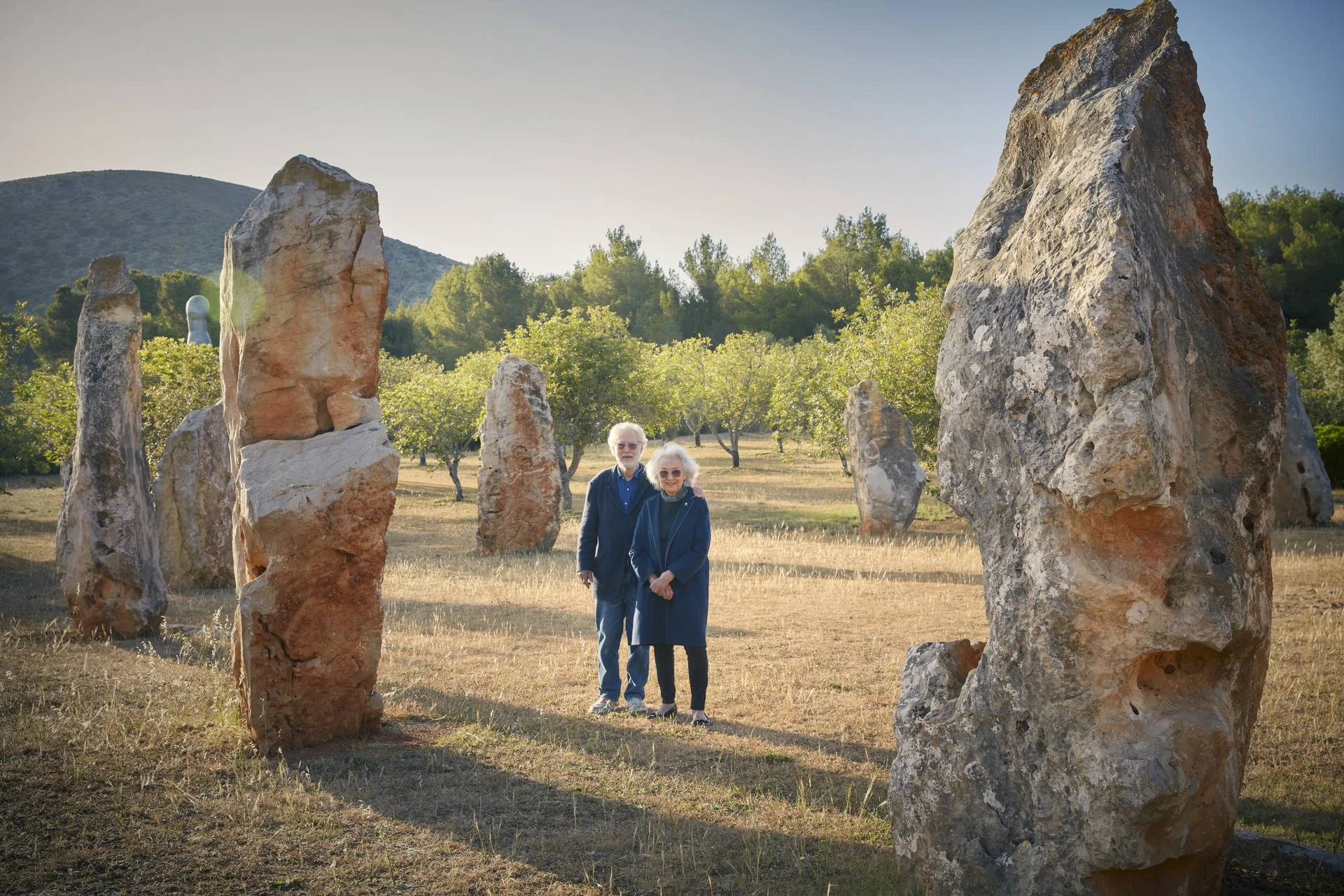
Yannick and Ben Jakober
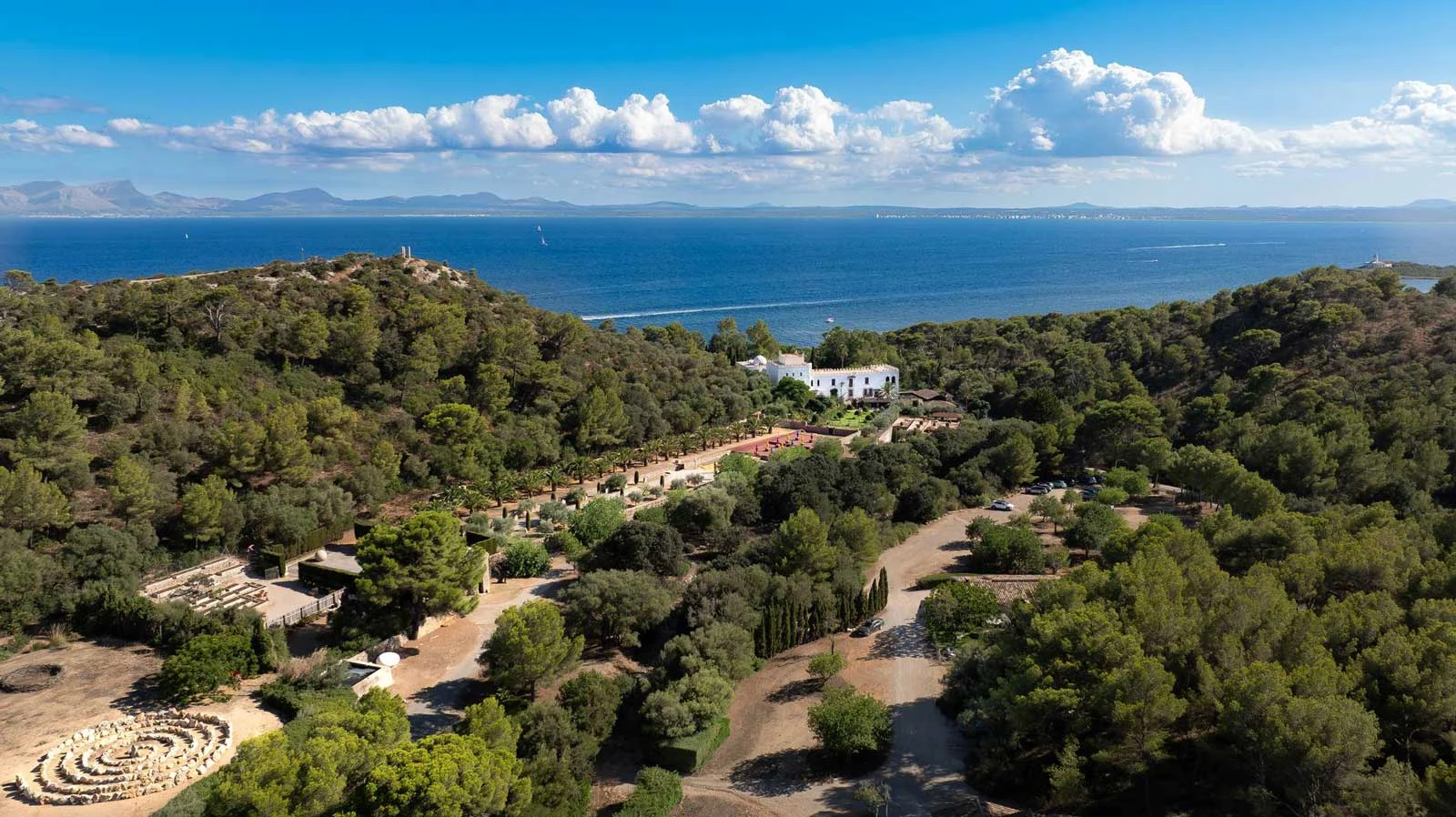
Aerial view of Sa Bassa Blanca
For the exhibition of an important collection of children’s portraits, built up over decades, an adjacent space has been created by conditioning an old underground cistern: the result is a contemporary space to present antique painting. Going down the stairs, completely hidden by ancient olive trees and native shrubs, a small hall leads to a series of rooms illuminated from above, with precise light points focusing on each of the works.
Read more
Read less
This lighting was designed by Alain Chevalier, who has worked at the Louvre and the Centre Pompidou. Here, you discover what might be the island’s best-kept secret: a unique collection, specializing in the theme of children’s portraits dated between the 16th and 19th centuries. Some of the paintings depict royal infants, others are more popular or naïf. Many of the works are by known artists, such as Andrés López Polanco, Bartolomé González, Miguel Jacinto Meléndez, Antonio Carnicero, Juan Carreño de Miranda, Frans Pourbus the Younger, Jacob Gerritsz Cuyp, Cornelis de Vos, Charles Beaubrun, Jean-Baptiste Oudry, and Nicolas de Largillière; others are attributions or remain anonymous.
This intriguing collection, formed over many years by true art lovers, allows us to follow not only the evolution of painting but also of fashion, and leads us to remember the history of Europe through royal children and their marriage politics. The collection has been declared a Registered Asset of the Heritage of the Balearic Islands.
In 2008, another space called SoKrates was added to the artistic complex, an underground room acting as a Wunderkammer that confronts ancient artifacts from Nepal, Tibet, and Peru with a fossil of a Pleistocene rhinoceros before a curtain of 10,000 crystals donated by Swarovski, and with works by contemporary masters such as Miquel Barceló, José María Sicilia, Gerhard Merz, and Jannis Kounellis.
It is very likely that you will encounter school groups when visiting the Foundation because the educational program currently being carried out is a priority over any other activity. The challenge is to open a window to art for these young people, and already more than 4,500 visit the museum annually.
Over recent years, the Foundation has achieved significant international exposure, thanks to the organization of temporary exhibitions of part of its collections that have traveled to museums such as the Museum of Fine Arts of Valencia, the FAP of São Paulo, the Kunst und Austellungshalle der Bundesrepublik Deutschland in Bonn, the Museum of Fine Arts of A Coruña, the Frist Center for the Visual Arts in Nashville, the State Historical Museum in Moscow, the Pera Museum in Istanbul, or the Casa del Cordón in Burgos. At the same time, some works by Domenico Gnoli have been exhibited in other art centers, such as the Galleria Civica in Modena or the Centro per l’arte Contemporanea in Prato. In 2012, an exhibition of the work done in New York from 1964-69 was organized, and in 2013, the Foundation lent six works that were exhibited in the central Pavilion of the Venice
Biennale.
The founders, Ben and Yannick Jakober, who are also artists, have works in various international museums and have participated in several biennales. Visitors can walk through the Foundation’s Sculpture Park contemplating some of their most notable works, such as the three large stone columns on the mountaintop illuminated at night; several large-scale sculptures, made of granite representing animals and inspired by different cultures such as Japanese, Persian, Egyptian, or Chinese; and the spectacular Stele of the Sun (Estelas del Sol), a personal interpretation of ancient megalithic monuments consecrated to magical rituals, which dialogues with a recent work called Little People, a circular granite sculptural group whose figures extend their arms as if wanting to touch each other.
Furthermore, several public commissions by the artists can be seen in public places on the island, including the Amphora at Palma Airport. After everything I have told you, I suppose we will agree that it is much better to see it in person, so be sure to arrange an appointment via email or phone.
